


Anubis Smokes in CS2
Anubis Smokes in CS2
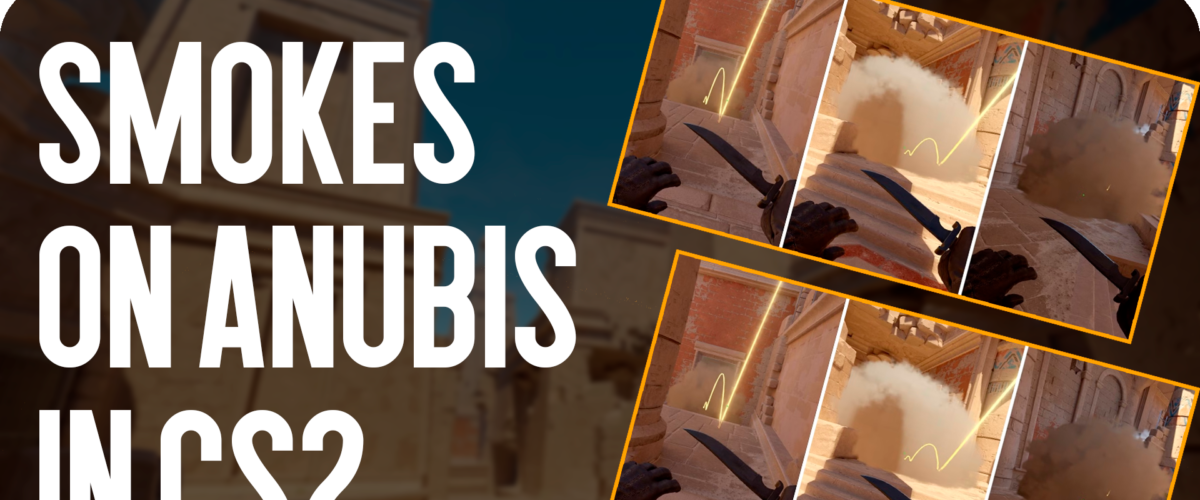
Anubis is one of those Counter-Strike 2 maps where proper grenade usage can completely change a round. Because of its open spaces, long sightlines and numerous routes, smoke grenades do more than simply block an opponent’s vision. They create new paths for an attack, cut defenders away from the action and give your team safer ways to take space.
If you want to know which Anubis smokes CS2 players should learn first, this guide focuses on practical lineups rather than a huge list of rarely used throws. The goal is simple: finish reading and know what to throw, where to throw it and what your team should do immediately afterward.
Anubis returned to the Active Duty pool in January 2026, replacing Train. Valve has also continued developing built-in map learning tools: since March 2026, limited map guides have been available in Competitive and Retakes during the first five rounds.
If you are learning the map for the first time, it is worth combining these tools with Practice Mode and the official Counter-Strike 2 website.
The Anubis smokes you should learn first
You do not need twenty lineups immediately. Start with five or six reliable grenades that work in common situations.
| Smoke | Side | Purpose | Best use |
|---|---|---|---|
| A Main → A Site | T | Block defender vision | A execute |
| A Heaven | T | Isolate high position | A take |
| Mid/Bridge | T | Limit central control | Mid pressure |
| B CT/Back | T | Cut rotation | B execute |
| B Long | T | Reduce exposed angles | B take |
| Retake Smoke | CT | Split attacking players | Retake |
The important rule is simple: every smoke should have a purpose. Throwing a $300 grenade because “that is what the lineup says” is not enough. Your team needs to use the space created by it.
A Site can become difficult when Terrorists enter without utility. A defender can hold a long sightline, get the opening kill and force the attack to slow down.
That is why the basic A execute should be built around cutting off important defensive angles.
A simple sequence is:
- One player throws the main Smoke.
- A second player throws a Flashbang.
- The team takes A Main space.
- Players continue moving instead of waiting in the Smoke.
- The last player watches the possible rotation.
The purpose of Anubis smokes CS2 on A is not to cover the entire site. It is to divide the area into safe and dangerous sections.
Player feedback: players commonly value A smokes because they make the execute much more consistent when everyone understands where to move after the smoke lands.
Heaven: why this smoke can decide the round
Heaven is a position that should never be ignored. Even after winning the first duel, a defender in the elevated area can stop the rest of the attack with a few accurate shots.
Before entering A, think about which sightlines will remain open after your first Smoke.
A useful sequence is:
Smoke → Flash → entry → clear close angles → plant.
Do not send all five players through the same doorway at once. The first player creates space, the second plays for the trade, another controls a longer angle and the remaining players prepare for the post-plant.
This approach is especially useful in solo queue because the visual information created by the Smoke makes your team’s intention easier to understand.
Mid and Water: the center of the map
A and B can win individual rounds, but Mid often determines how much freedom your team has during the entire round.
The central area connects important routes and forces CTs to respect possible splits. If you control Mid, you can threaten both bombsites and make defensive rotations uncomfortable.
This is where Anubis smokes are often used differently. The goal is not always to enter immediately. Sometimes the best Smoke is the one that denies information.
For example, your team can show pressure in Mid, throw a Smoke, take a few steps forward and stop. CT players may react by using utility or repositioning. Your team can then switch to A or B.
Player feedback: many experienced players consider Mid control one of the most frustrating aspects of defending Anubis. Giving the center away for free leaves CTs with fewer comfortable options.
B Site: utility before the execute
B generally rewards a more structured approach. Without grenades, attackers have to clear several possible defensive positions while exposed.
The purpose of a B Smoke is to remove at least one important sightline and force the defender to make a decision.
A basic B sequence can be:
- Smoke the long defensive angle.
- Flash over the route.
- Molotov a common hiding position.
- Add a second Smoke to cut the rotation.
- Enter with two players together.
- Use the remaining players for trades and flank control.
You do not have to repeat the same execute every round. If the opponents expect B every time, show B pressure and then move through Mid.
Using utility for a fake
One of Anubis’ strongest features is the ability to manipulate rotations.
Imagine two players throwing Smokes and Flashbangs toward A. The team does not actually commit. CT players may start rotating toward the site.
A few seconds later, four Terrorists can appear near B.
This is why CS2 grenades are not simply tools for entering bombsites. They are information-management tools.
A good fake needs to look believable. One random Smoke rarely convinces an experienced defense. Combine utility with sound, positioning and enough player presence to create a real threat.
Playing Anubis as CT
The biggest defensive mistake is using every grenade during the first ten seconds.
If you instantly spend Smoke, Flash and Molotov while the Terrorists have not committed, you may have nothing left for the important part of the round.
Instead, split your utility:
- early Smoke to slow pressure;
- Molotov to delay an entry;
- Flash for a second fight;
- another Smoke for the retake;
- HE when several enemies are grouped together.
Do not give up Mid for free. Once T players control the center, they can threaten multiple routes and force CTs to make uncomfortable rotations.
Playing Anubis as T
Terrorists do not have to spend every grenade immediately.
A strong default can involve one player holding A Main, two players working around Mid, one player watching B and one flexible player moving toward the first contact.
After the first 20–30 seconds, your team should know which CT grenades have already been used.
That information can be more valuable than having another complicated lineup.
The most common Smoke mistakes
Even a perfect lineup is useless when used at the wrong moment.
Mistake #1 — Smoke without a follow-up.
The player throws the grenade but nobody takes the space.
Mistake #2 — repeating the same execute.
The enemy learns your timing and starts countering it.
Mistake #3 — no Flash support.
Smoke blocks vision, but the defender can still stand behind it and wait.
Mistake #4 — wasting utility too early.
The team reaches the execute with nothing left.
Mistake #5 — ignoring the Smoke exit.
A defender can push through the cloud and get easy kills if nobody watches it.
How to practice Anubis smokes
Do not learn new lineups in ranked games. Spend 20–30 minutes in Practice Mode instead.
Find the exact lineup, then repeat it at least ten times.
A useful routine is:
- Five normal throws.
- Five throws after movement.
- Five throws under time pressure.
- Repeat the lineup in a realistic round.
Do not practice only the throw. Practice what happens immediately afterward. After the Smoke lands, know where you are going, which angle you clear and who is responsible for the trade.
Valve has also continued improving official map guides and grenade-related systems during 2026, giving newer players more tools for learning.
What to do after planting
Utility becomes even more important after the bomb is planted.
A Smoke can divide CT players and buy valuable seconds. Defenders then have to decide whether to wait for the cloud to disappear or risk moving through it.
For T players:
- do not group around the bomb;
- keep at least one Smoke when possible;
- use Molotov to delay the defuse;
- maintain control of important routes;
- avoid unnecessary fights.
For CTs, the goal is to gather information and force T players to reveal themselves before the final retake.
Why Anubis utility matters in 2026
Anubis was removed from the Active Duty pool in July 2025 and returned in January 2026.
Valve has also continued adjusting the broader grenade and map systems. In August 2026, the developers fixed an issue that could allow grenades to pass through map geometry.
That means old lineups should occasionally be checked after updates.
Quick pre-match checklist
Before your next match, ask yourself:
- Do I know two A Smokes?
- Can I block Heaven?
- Do I have a reliable B Smoke?
- Can I contest Mid?
- Do I keep utility for post-plant?
- Do I know which Flash follows my Smoke?
- Do I know what to do immediately after the grenade lands?
If most answers are yes, you already have a useful foundation.
For more CS2 guides and practical gaming content, follow Csgo-news.com.
FAQ
How many Anubis Smokes should I learn?
Start with five or six reliable grenades covering A, B and Mid. Add more advanced lineups once those become automatic.
Which grenades matter most on Anubis?
Smoke and Flashbang are the foundation. Molotovs are especially useful for delaying pushes and controlling post-plant positions.
Do I need to learn every lineup?
No. Four reliable grenades that you understand are more useful than fifteen lineups you rarely remember.
How quickly can I learn Smokes?
Choose five important grenades and repeat each one 10–15 times in Practice Mode. Then practice the action that follows the throw.
Do old Smokes always work after CS2 updates?
Not necessarily. Valve regularly changes map geometry, collision and grenade behavior, so important lineups should be checked after major updates.
Conclusion
Good Anubis utility is not about memorizing lineups mechanically. It is about understanding why you are throwing the grenade. Once these actions become one sequence, your executes become much easier to coordinate and much harder to stop.
Start with a small set of reliable A, B and Mid Smokes. Then add options for fakes, retakes and post-plant situations. After a few matches, you will stop thinking about individual lineups and start reading the round: this is the moment for a Smoke, this is where a Flash is better, and here the best grenade may be the one you save. That is when how to play Anubis becomes a real skill rather than a memorization exercise.
For players interested in CS2 inventory and skin-related content, you can also check Forcedrop.vip.
For more practical guides, map breakdowns and CS2 tips, follow Csgo-news.com.
👉 Want to learn more? Read here




[…] 👉 Want to learn more? Read here […]