


How to Get Your First Premier Rating
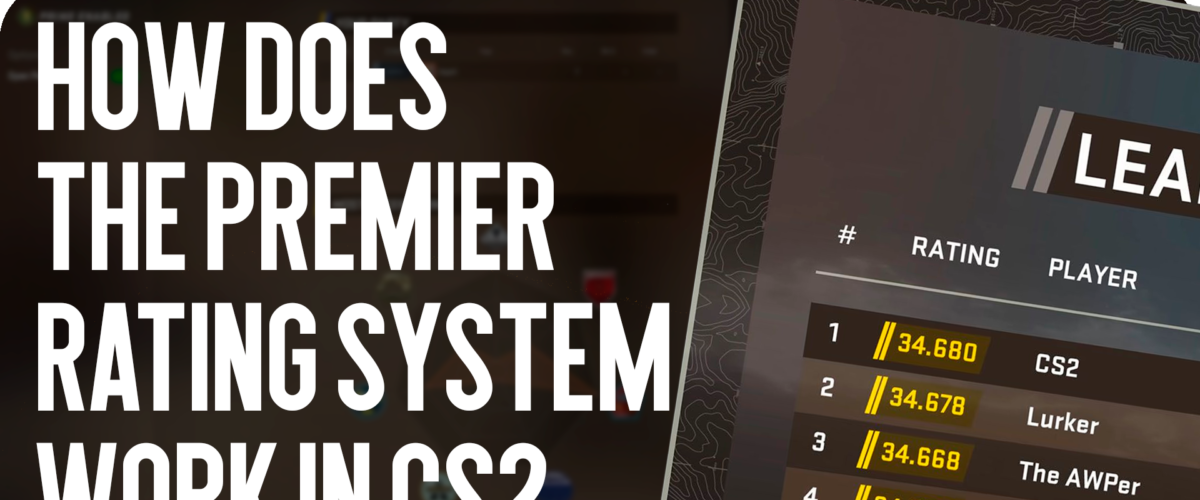
How the Premier Rating System Works in CS2
Premier Rating is one of the most important competitive systems in Counter-Strike 2. Instead of giving players only a traditional rank, Premier uses a numerical CS Rating that shows a player’s current position in the competitive environment. The number changes after matches, so every victory and defeat can affect your progress.
Csgo-news.com explains how Premier Rating works and, more importantly, what you should actually do if your goal is to improve your results. This Premier guide focuses on practical gameplay: how to get your first rating, how to understand the number before a match, why wins can provide different amounts of rating, how to avoid losing large amounts of points and how to build a consistent approach to climbing.
The official Counter-Strike 2 website describes CS Rating as a visible performance indicator that determines a player’s position in global and regional leaderboards. If you are also interested in skins, items and the wider CS2 economy, you can find additional gaming content on Forcedrop.vip.
What Is Premier Rating?
Premier Rating is the numerical rating used in the Premier competitive mode. It replaces the traditional rank system inside this mode with a specific number. This makes it easier to see relatively small differences between players.
For example, two players might have ratings of 10,200 and 12,700. Both may have the same general color, but their actual positions are different. The number gives players a much more detailed indication of where they currently stand.
The most important thing to understand is that Premier Rating is not a permanent title. It moves up and down depending on match results. If you consistently win more matches than you lose, your rating should generally increase. If you regularly lose, the opposite happens.
However, rating should not be treated as a perfect measurement of mechanical skill. Aim is only one part of Counter-Strike. Positioning, communication, utility usage, economy management, timing and decision-making can have an enormous impact on the final result.
CS Rating Colors and Rating Ranges
The number is displayed together with a color. The color makes it easier to identify the general rating range, while the exact number is more useful for tracking progress.
| CS Rating | Color | General range |
|---|---|---|
| 0–4,999 | Gray | Starting level |
| 5,000–9,999 | Light blue | Beginner to lower-mid |
| 10,000–14,999 | Blue | Mid range |
| 15,000–19,999 | Purple | Advanced |
| 20,000–24,999 | Pink | High rating |
| 25,000+ | Red | Very high rating |
These colors should not be treated as exact skill divisions. A player at the bottom of a range can play very differently from someone near the top.
For this reason, do not judge your progress only by color. Going from 10,100 to 11,000 is still meaningful progress even though the color has not changed.
How to Get Your First Premier Rating
Before receiving an initial rating, a new player has to complete the required calibration process. The system needs enough results to determine an appropriate starting position.
Calibration should not be treated as a race for kills. A player who finishes with many kills but makes poor decisions can still lose the match.
Before starting calibration, prepare properly:
- Warm up your aim.
- Practice basic utility on your strongest maps.
- Keep your sensitivity and crosshair stable.
- Avoid playing while extremely tired.
- Choose a role you understand.
- Communicate important information.
- Focus on winning rounds rather than farming kills.
The biggest mistake is trying to prove that you are the strongest player in every round. Counter-Strike rewards good decisions, not constant aggression.
If you are playing as a CT, you do not have to search for an early duel every round. If you are playing as a T, you should not enter a bombsite alone without support simply because you want the opening kill.
How Does Rating Change After a Match?
One of the most useful features of Premier is the rating prediction shown before the match. It allows players to see the potential effect of a win or loss before committing to the game.
This is important because a victory does not always provide exactly the same number of points.
Players sometimes look for a simple formula such as “one win equals 300 points” or “every ten kills give extra rating.” That is not a reliable way to understand the system.
Valve does not publish every detail of the complete rating calculation. Because of that, unofficial formulas found in old guides should not be treated as guaranteed mechanics.
The practical rule is much simpler: look at the expected rating change before the match and understand what is at stake.
If a loss could cost a significant amount, unnecessary aggression becomes even less attractive.
Why Can Two Wins Give Different Amounts of Rating?
The Premier system is designed to position players relative to the wider competitive population rather than simply giving the same reward after every victory.
This means that two consecutive wins can result in different rating changes.
For example:
| Match | Result | Example change |
|---|---|---|
| Match 1 | Win | +350 |
| Match 2 | Win | +250 |
| Match 3 | Loss | −300 |
| Match 4 | Win | +320 |
The exact values above are only an example of how rating changes can differ. The important lesson is not to expect every victory to produce the same result.
Instead of asking “How many points will I get from this one win?”, think about your long-term record.
A player who wins consistently does not need to win every match. The goal is to create a positive trend over a large number of games.
Does K/D Directly Determine Rating?
This is one of the most common questions among players.
A high K/D is useful because it often indicates strong individual performance, but it does not mean that the system simply converts kills into rating points.
You can finish a match with 30 kills and still lose.
You can also finish with a modest K/D and make a huge contribution through flashes, smokes, trades, information and clutch decisions.
This is why chasing kills can sometimes hurt your rating. A player may take unnecessary fights simply to improve the scoreboard while creating disadvantages for the team.
A better question is:
Did my decisions increase the team’s chances of winning the round?
That mindset is much more useful for long-term improvement.
What Usually Stops Players From Ranking Up?
Many players assume that their rating problem is caused by weak aim. Sometimes that is true, but repeated decision-making mistakes are often more important.
Common problems include:
- giving away the first kill;
- taking the same duel repeatedly;
- pushing without support;
- ignoring the economy;
- wasting utility;
- failing to trade teammates;
- not communicating enemy positions;
- rotating too early;
- rotating too late;
- playing too aggressively after losing several rounds;
- becoming tilted.
If you constantly die first, simply playing more Deathmatch may not solve the problem.
Ask yourself why you are dying.
Finding the reason is more valuable than simply increasing your number of games.
How to Play for Consistent Rating Growth
A good Premier guide should give players practical rules that can be applied immediately.
1. Protect the First Advantage
The opening kill is extremely valuable. However, that does not mean you should force an opening duel every round.
If you are defending, sometimes the correct decision is simply to stay alive and deny the enemy easy access to the site.
If you are attacking, use flashes and trades instead of entering alone.
2. Understand the Economy
Economy can decide entire halves.
Before buying, check:
- your own money;
- your teammates’ money;
- available rifles;
- utility;
- potential AWP purchases;
- the enemy economy.
Do not automatically force-buy because you lost the previous round.
Sometimes a weak purchase creates another weak round. Saving for a full buy can give your team a much better chance.
3. Use Utility With a Purpose
Every smoke, flash or Molotov should have a reason.
Throwing utility randomly is much less effective than using it to support a specific action.
4. Trade Your Teammates
If your teammate enters a site, your job is often to be close enough to trade.
You do not always need to get the first kill.
Sometimes getting the second kill and preventing the enemy from holding the bombsite is the correct play.
5. Communicate Useful Information
Good communication should be short and clear.
Instead of shouting after dying, provide information such as:
- “Two A.”
- “One low.”
- “AWP mid.”
- “Bomb B.”
- “One pushing.”
- “No utility.”
Useful information gives your teammates a chance to make better decisions.
What Should You Do During a Losing Streak?
Losing streaks are dangerous because players often change their behavior after several defeats.
A player loses two games and starts forcing every duel.
Then another game is lost, and the player starts taking even more risks.
Eventually, the problem is no longer the opponents. The player is making decisions emotionally.
If you are losing repeatedly:
- Stop after several frustrating games.
- Take a break.
- Do not immediately queue to recover lost points.
- Review your biggest mistakes.
- Return with a clear mindset.
- Focus on individual rounds rather than your rating.
The phrase “I need to win this game because I lost 500 rating” is usually a bad mindset.
You cannot control the final rating number during a round.
You can control your crosshair placement, positioning, utility, communication and decisions.
How Many Maps Should You Master?
You do not need to be equally strong on every map.
For many players, mastering two or three maps is a much better approach.
For each main map, learn:
- common smoke lineups;
- standard CT positions;
- common T setups;
- entry routes;
- retake positions;
- important timings;
- common off-angles;
- economy patterns.
The map pool also changes over time, so old guides can become outdated.
In July 2026, Valve launched Premier Season 5, with Cache returning to Active Duty and Overpass leaving the active map pool. This means players who want to climb should update their Cache utility and positioning knowledge instead of relying entirely on older strategies.
Is It Possible to Reach a High Rating Quickly?
Yes, rating can move relatively quickly, but that does not mean you should try to force rapid progress.
If your skill level is significantly higher than your current rating, consistent results should eventually move you upward.
The mistake is expecting the system to prove your skill after five games.
Use a larger sample.
Twenty or thirty matches provide much more useful information than one good evening.
If your rating repeatedly returns to the same range, this can be a sign that you have reached your current performance level.
At that point, playing another hundred matches without changing anything may not solve the problem.
You need targeted improvement.
How to Track Your Progress
You do not need a complicated analytics system.
Record a few simple details after every match:
- rating before the game;
- rating after the game;
- map;
- result;
- K/D;
- role;
- biggest mistake.
After 20–30 games, look for patterns.
Maybe you win most of your games on one map but consistently lose on another.
These patterns are more useful than simply looking at the rating number.
What Changed in Premier in 2026?
The competitive environment continues to change as Valve updates CS2.
Premier Season 5 launched in July 2026 and changed the Active Duty map pool by bringing Cache back and removing Overpass.
This is important for players who use older strategies.
A smoke lineup may still work, but the way players approach a position can change because of the current meta.
If your goal is to improve your CS2 rating, keep your map knowledge updated after major updates.
Do not assume that a strategy from several months ago is still optimal today.
A Simple Routine for Climbing
If you want a practical routine, keep it simple.
Before playing:
- Warm up for 10–15 minutes.
- Practice a few important sprays.
- Review two or three utility lineups.
- Decide which maps you are comfortable playing.
- Start Premier only when you are focused.
During the match:
- Do not chase unnecessary kills.
- Communicate.
- Watch the economy.
- Trade teammates.
- Use utility before taking difficult fights.
- Adapt when opponents read your strategy.
After the match:
- Check the rating change.
- Identify your biggest mistake.
- Decide whether you are mentally ready for another game.
- Stop if you are clearly tilted.
This routine is more sustainable than playing six or seven matches while frustrated.
FAQ
What is Premier Rating in CS2?
Premier Rating is the numerical CS Rating used in Premier to show a player’s position in the competitive system. It changes based on match results.
Why do I get different amounts of rating for wins?
The system does not simply award exactly the same number of points for every victory. The expected rating change can differ between matches.
Does K/D directly give rating?
There is no simple official rule where a specific number of kills automatically converts into a fixed number of rating points. Winning the match remains the key objective.
What should I do if I keep losing rating?
Stop trying to immediately recover lost points. Take a break, identify repeated mistakes and return when you can play with a clear mindset.
Should I play every map?
No. Learning two or three maps very well can be more effective than having limited knowledge of the entire pool.
What is the fastest way to improve CS2 rating?
Focus on winning rounds rather than chasing statistics. Improve aim, utility, positioning, economy, communication and decision-making.
Does the Premier system change between seasons?
Yes. Valve can change the map pool and other elements of the competitive experience.
Should I play Premier every day?
Not necessarily. If you are tired, frustrated or tilted, playing more matches can make your results worse.
Is high Premier Rating proof that a player is better?
It is a useful competitive indicator, but it does not measure every part of a player’s skill. Individual mechanics, communication and tactical understanding can vary.
How many matches should I use to evaluate my progress?
A sample of around 20–30 matches is much more useful than judging yourself from one or two games.
Conclusion
The best way to understand Premier Rating is to treat it as a long-term measurement of your competitive results. Specifically, it should not be viewed as a number that must be increased at any cost. If you want to climb consistently, focus on the things you can control. These factors include your aim, positioning, utility, economy, communication, trades, and decision-making.
Before each match, look at the expected rating change so you understand the risk. However, do not let one defeat control your entire session. If you lose several games in a row, stop and reset. Consequently, you will avoid tilting instead of immediately trying to recover every lost point. Track your results over 20–30 matches and look for repeated patterns.
If you constantly struggle on one map, you must improve that specific map pool. Furthermore, the 2026 Premier environment requires players to keep their map knowledge current, especially after the recent changes to the Active Duty pool. A strong rating is never created by one lucky winning streak. As a result, sustainable progress comes from making slightly better decisions in hundreds of rounds and turning those decisions into consistent victories.
👉 Want to learn more? Read here






[…] 👉 Want to know more? Read here […]