What Will Happen to the Skin Market in CS2: Why It Will Only Get Worse, What to Expect?
What Will Happen to the Skin Market in CS2: Why It Will Only Get Worse, What to Expect?
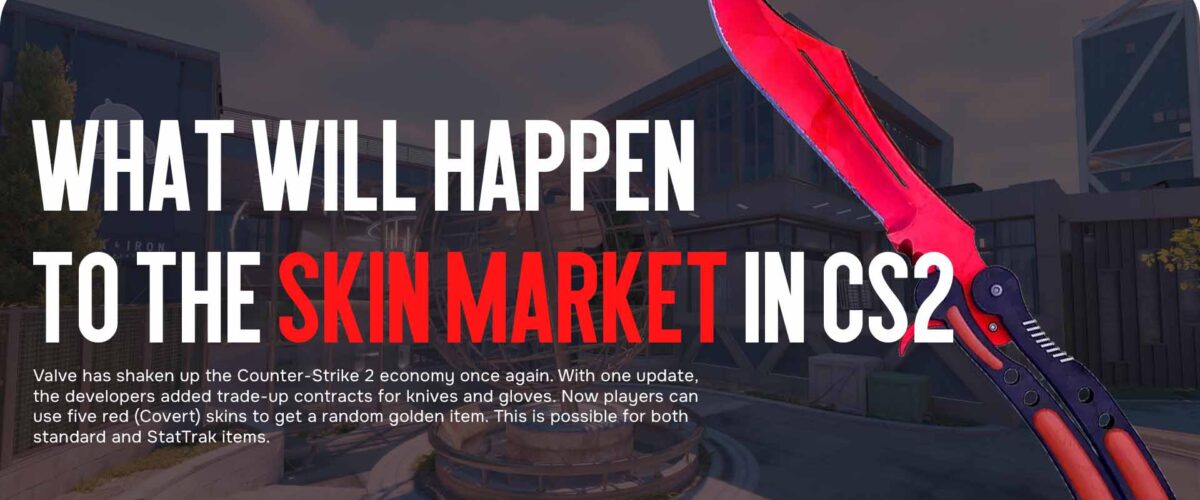
Valve has shaken up the Counter-Strike 2 economy once again. With one update, the developers added trade-up contracts for knives and gloves. Now players can use five red (Covert) skins to get a random golden item. This is possible for both standard and StatTrak items.
The essence is simple:
-
5 red skins from the same cases = 1 golden item;
-
the result depends on the case type — either a knife or gloves;
-
the chance is completely random.
The community had been asking for years to add the ability to craft knives without cases — and it finally happened. But the joy was short-lived: a few hours after the update’s release, the skin market crashed. This is how the CS2 skin market crash began, the consequences of which we are still observing.
The Market’s Instant Reaction
The market reacted instantly. Prices for knives and gloves began to fall rapidly — some items lost over 50% of their value in just 24 hours.
Panic gripped traders: some rushed to sell their inventories to minimize losses, while others, on the contrary, began actively buying the fallen items hoping for a quick recovery.
However, in this chaos, a pattern can be discerned — Valve knew exactly what it was doing. This move is not an accident, but a logical continuation of the strategy started with the appearance of the Genesis Terminal and the overhaul of the in-game economy.
Why Valve Took This Step
For many years, Steam earned huge money from market commissions — about 15% from each transaction. But with the growth of third-party trading platforms, a portion of the profit went there.
Valve limits the sale price on Steam to about two thousand dollars, whereas external sites allow free trading. To bring activity back to its own market, the company apparently decided to make rare items more accessible.
This way, the developers kill two birds with one stone:
-
they increase the number of transactions on Steam, bringing back commissions;
-
they reduce the game economy’s dependence on external platforms.
In essence, the CS2 skin market crash could be part of a plan to reboot the economy — where item value will be formed within Steam, not outside of it.
Possible Market Development Scenarios
Experts and traders identify three most likely scenarios for the development of the situation.
1. Stabilization Thanks to Large Investors
If owners of large inventories start buying up devalued knives and gloves, the market could hold. Similar mechanisms work in the crypto environment — when large players “hold the floor” to prevent prices from crashing.
2. Complete Price Crash
If traders and investors leave, prices will continue to fall. In this case, we could see Butterfly knives for $20 and gloves for $10. Rare items would cease to be exclusive, and the market would lose the elitism it had maintained for years.
3. Increased Interest in Old Collections
With falling prices for new skins, player attention might shift to classic items that can no longer be unboxed:
AWP Dragon Lore, AK-47 Vulcan, M4A4 Fade, and others. These “old-school” skins could become the new status currency in CS2.
A Step Towards a New Economic System
Some players believe the current update is just the beginning of a large-scale reform. Valve is gradually moving towards a system where skin trading will not happen for real money, but through in-game tokens, stars, or other types of currency.
If this happens, the value of skins will cease to depend on the real market. The system will become closed, which will radically change the perception of items in CS2. Players will stop viewing them as investments — skins will become just a customization element again, not a financial asset.
What This Means for Ordinary Players
Paradoxically, the CS2 skin market crash could play into the hands of ordinary users.
Prices for premium items have already fallen, and now even a beginner can afford a knife or gloves that used to cost hundreds of dollars.
From a gameplay experience perspective — this is a positive change. CS2 is becoming more accessible and visually diverse: every player can choose a unique style for themselves without spending huge sums.
Long-Term Consequences for Traders
For professional traders, the situation looks bleaker. Investments made in rare items could depreciate. Furthermore, market recovery will take months, if not years.
Some experts believe the market could “bounce back” if Valve limits the trade-ups or changes the item drop algorithm. But for now, there are no such statements, and investors prefer not to take risks.
The CS2 skin market crash has become a signal: the system no longer guarantees stable price growth. Now even the rarest items are subject to volatility, just like in a real economy.
The CS2 Market Will Never Be the Same Again
Valve has taken a step that has changed the entire CS2 ecosystem. Adding contracts for golden items became the trigger for a large-scale redistribution of values.
Now the market is divided into two parts:
-
the gaming part — where appearance and emotions matter;
-
the investment part — where interest in skins is determined by profit.
While the first group is winning, the second is suffering losses. But this was precisely Valve’s goal — to restore the balance between gaming pleasure and trade speculation.
The CS2 skin market crash is not the end, but the beginning of a new era. Players will get more opportunities, the market will become more dynamic, and the economy — less dependent on external sites. Perhaps CS2 will become the first game where in-game values finally cease to be financial instruments and become again what they should be — part of the enjoyment of the game.
Full review of the CONTROL CS2 collection is already in our article! [Read…]