Why Bullets “Miss”: An Analysis of the CS2 Subtick System
Why Bullets “Miss”: An Analysis of the CS2 Subtick System
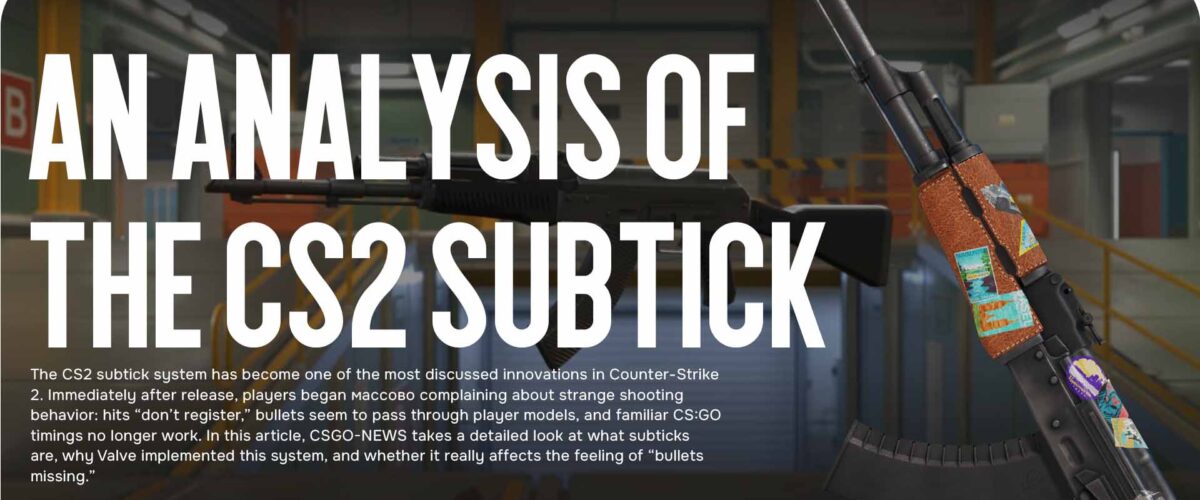
The CS2 subtick system has become one of the most discussed innovations in Counter-Strike 2. Immediately after release, players began массово complaining about strange shooting behavior: hits “don’t register,” bullets seem to pass through player models, and familiar CS:GO timings no longer work. In this article, CSGO-NEWS takes a detailed look at what subticks are, why Valve implemented this system, and whether it really affects the feeling of “bullets missing.”
What Is Tickrate and Why It Matters
To understand how the CS2 subtick system works, you first need to understand a basic concept — the tick.
A tick is a single update of the game world on the server. During each tick, the server records:
-
positions of all players;
-
their actions (movement, shooting, jumping);
-
the state of the map and objects;
-
hits and damage.
In the classic model, the server updates the game state 64 times per second, meaning approximately every 15.6 milliseconds. This is the frequency at which the client and server exchange information.
The higher the tickrate, the more accurately the server “understands” what happens in the game. This is why differences between tickrates have always been especially noticeable at the competitive level.
Why Valve Abandoned the Traditional Approach
In Counter-Strike 2, the developers decided to rethink the very logic of processing player actions. Instead of rigidly tying actions to a specific tick, the CS2 subtick system was introduced.
The key idea is simple:
player actions are recorded not “inside a tick,” but in the time between ticks.
Each action — a shot, the start of movement, stopping — receives a timestamp. The server then builds all events into an exact chronological sequence and only after that forms the final state of the round.
How the CS2 Subtick System Works in Practice
Technically, the system works as follows:
-
The client sends data about the player’s action with the exact time it occurred.
-
The server receives packets from all players.
-
Actions are sorted by timestamps.
-
The final state of the round is calculated based on the real order of events.
It is important to understand that the server still updates at a fixed frequency. However, it no longer ignores actions that occurred between ticks and instead accounts for them more precisely.
This is exactly what Valve calls subticks.
Why CS2 Sends More Data Than CS:GO
Analysis of network activity shows that Counter-Strike 2 transmits noticeably more data than the previous version of the game. This is due to the new packet exchange architecture.
Two types of packets are used:
-
main packets — sent at intervals close to the classic tick;
-
additional packets — contain priority actions with timestamps and arrive almost immediately after the main packet.
This scheme allows the server to receive critically important information faster, such as shooting data.
Why It Feels Like Bullets Miss
Despite the theoretical advantages, the CS2 subtick system has become the source of subjective discomfort for part of the player base.
Main reasons:
-
broken muscle memory from CS:GO;
-
differences in how strafes and stops are processed;
-
visual desynchronization between animations and hit registration;
-
increased sensitivity to ping and connection stability.
The player shoots at a moment that visually feels correct, but the server records the action a fraction of a millisecond differently. As a result, it feels like the hit “didn’t register.”
Why New Players Adapt More Easily
An interesting CS2 paradox is that newcomers complain about subticks much less. The reason is simple:
they don’t have habits from CS:GO.
Veterans spent years refining timings under the old tickrate model. The new system requires a different approach:
-
cleaner stops;
-
less reliance on “feeling the moment”;
-
more trust in server-side registration.
New players perceive CS2 as a separate game and adapt to its logic faster.
Does CS2 Still Run on 64 Ticks?
Despite loud statements, factual analysis indicates that official servers still use a base frequency of 64. The difference lies not in the number of updates, but in how actions are processed.
Valve does not disclose exact technical parameters, but delays between main packets indirectly confirm that the previous tickrate is preserved.
Thus, the CS2 subtick system does not replace tickrate — it is layered on top of it.
Subticks vs Tickrate: The Bottom Line
From a conceptual standpoint, Valve is trying to smooth out the difference between low and high update rates. In theory, subticks should:
-
increase action registration accuracy;
-
reduce the impact of network latency;
-
make gameplay more fair.
In practice, the system still requires refinement. This is why some players experience unstable shooting and “bullets missing.”
CSGO-NEWS Conclusion
The CS2 subtick system is neither a myth nor a marketing gimmick — it is a real change to the game’s network architecture. However, its impact is not felt immediately and not equally by everyone.
Hit registration issues are most often related not to “broken shooting,” but to:
-
adapting to new timings;
-
visual desync;
-
habits carried over from CS:GO.
CS2 is a new game with new logic. And the faster a player adapts to subticks, the less it will feel like bullets are flying past.
Everything about the CS2 economy is already in our article! [Read…]